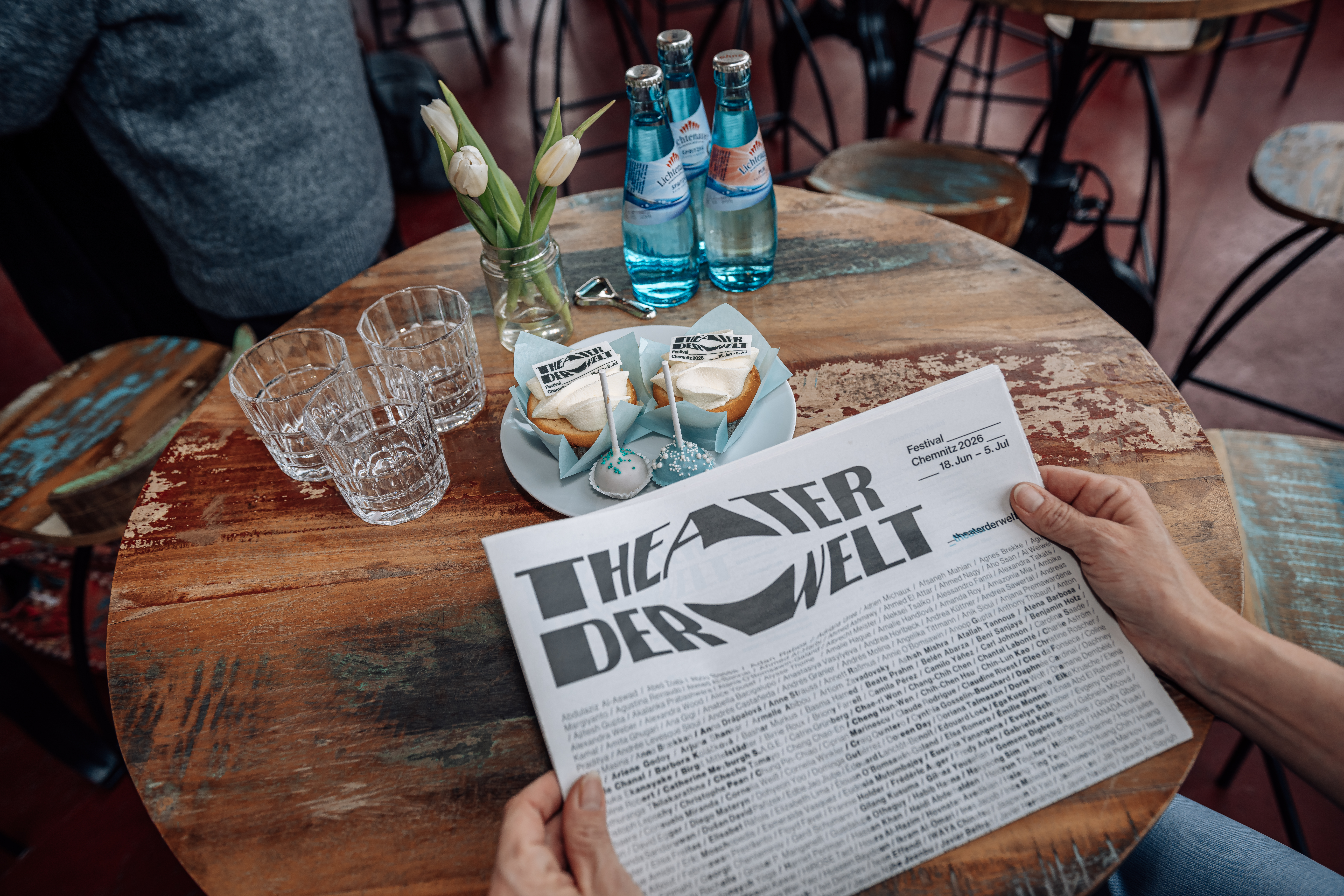
The full festival programme was presented at today's press conference.
Global themes, individual forms, many perspectives
33 productions from all continents can be experienced from 18 June to 5 July 2026 at the THEATER DER WELT festival in Chemnitz and thus for the first time in Germany. With puppet theatre from Indonesia, drama from the Czech Republic, a participatory installation from Australia, an XR performance from Taipei, a pop opera from South Africa and music theatre from India, the festival will showcase the great diversity of current international stage arts. Directly following the European Capital of Culture Year 2025, Chemnitz continues to focus on culture as a means of understanding, dialogue and exchange.
The festival will open with two very different works that highlight the breadth of the programme in terms of content and aesthetics: the participatory installation Paper Planet by Australia's Polyglot Theatre, in which the audience is actively involved and creates a walk-in world itself, and the European premiere of Split Tooth: Saputjiji by Canadian artist Tanya Tagaq - a powerful combination of music, literature and performance about indigenous identity and self-empowerment.
For the first time in the festival's history, a team of nine international curators will share the artistic direction of Theatre of the World. The programme thus brings together works that were created under very different cultural and political conditions in different regions of the world - and yet deal with common global themes. Questions of identity, origin, power relations and visibility run through many of the productions. For example, Nigamon/Tunai by Émilie Monnet and Waira Nina from Canada and Colombia or the installation performance Vortex Nukak by Colombian Mapa Teatrosmake the voices of indigenous communities audible and negotiate their experiences with colonialism and resource exploitation. In the productions Go Back to Where You Came From by the Portugal-based Brazilian artist Keli Freitas and Mutikkappata by Nathalie Vairac, the artists explore their own multinational origins and the resulting question of belonging.
Political realities and their individual effects on the respective society are another thematic link in the programme. In Mezok, for example, Indian author and director Jyoti Dogra unfolds a contemporary drama about the world of work characterised by acceleration and migration in the country with the world's largest population. In his work Before the Revolution , director and author Ahmed El Attar brings to life the state of society in Egypt before the start of the "Arab Spring", characterised by fear, stagnation and a longing for the future. In The Shadows, the Shieveh Theatre Company from Iran tells the story of people from the present day by linking their stories with figures from ancient tragedies and visualising similar patterns of action.
Current political conflicts are also addressed: Driven by the cruelty of Russia's war of aggression on Ukraine, Czech director Dušan David Pařízek 's production Amadoka seeks a narrative of how the systematic erasure of being and memory affects a society. In a co-production with the Theatre of the World Festival Chemnitz 2026, he is currently developing a play based on the epochal trilogy of novels by Ukrainian author Sofia Andrukhovych at the Divadlo X10 theatre in Prague.
The Russian-Norwegian production Tirvv. Divided addresses the effects of geopolitical borders on indigenous communities in the context of this war.
The festival premiere Luftmasse (Air Mass) by the Paper Tiger Theatre Studio collective, based in China and Germany, takes Alfred Döblin's future novel "Mountains Seas and Giants" about the rise of China as a threat to the Western-dominated world order as the starting point for an installative performance with dancers, singers and actors.
Some of the artists' works deal with different forms of coexistence. In FAMILY TRIANGLE, a Taiwanese performance collective brings its own queer family model to the stage, while in Los bienes visibles, Argentinian author Juan Pablo Gómez brings audience and players together in an acoustic space to reflect on the process of saying goodbye.
Choreographer Ivo Dimchev also invites audiences and performers alike to take part in a communal experience, transforming the intoxicating potential of Johann Strauss' music into a musical workout at Club Atomino.
The themes running through the programme find their expression in different aesthetic forms. With Antuco, for example, the Chilean group Silencio Blanco translates the deeply resonant tragedy surrounding the death of 44 young soldiers during a military exercise in 2005 into visually powerful puppet theatre without words. The Indonesian Papermoon Puppet Theatre also tells a story about the longing for closeness and connection in Stream of Memory without words, but with a giant figure called Kali and with light and movement. The precious resource of water and its unequal distribution is the subject of the puppet theatre Parole d'eau Water Words, a work by the Senegalese artist Mamby Mawine and the Canadian puppeteer Hélène Ducharme.
In an exciting mix of technology and performance, the Taiwanese-Canadian-Greek production BLUR takes a small group of viewers into an extended reality world and confronts them with the question of how we deal with finiteness in our highly technologised present.
The Palestinian Khashabi Theatre and the Indian aRanya Theatre are guests with contemporary interpretations of traditional material.
Great musical theatre comes from South Africa: the pop opera Nkoli: A Fierce & Fabulous Life combines protest songs and club sounds with voguing and ballroom culture to create a rousing show about power relations, belonging and resistance.
The programme for the 17th edition of Theater der Welt was developed by nine international curators in a collective process: Simon Abrahams from Australia, Joshua Dalledonne from Canada, Rodrigo González Alvarado from Argentina, Faye Kabali-Kagwa from South Africa, Nikos Mavrakis from Greece, Aya Nabulsi from Saudi Arabia, Srishti Ray from India, Ndèye Mané Touré from Senegal and ZHANG Yuan from China. The result is a polyphonic dramaturgy from different cultural contexts that deliberately juxtaposes different perspectives. The audience is invited to engage in dialogue and exchange with the artists before and after the performances. Part of the programme is explicitly aimed at young audiences and families. There are free offers and the opportunity to participate.
Theatre of the World is a festival of the German Centre of the International Theatre Institute (ITI), which is awarded to a different German city every three years. The current edition is being organised by Chemnitz Theatre, a 5-division theatre, in cooperation with the European Capital of Culture Chemnitz 2025 gGmbH and the Festival Academy Brussels. The ITI presents itself in the programme of Theater der Welt Chemnitz 2026 with, among other things, the awarding of the ITI 2026 prize to the performance artist Nicoleta Esinencu.
Get your tickets now !
Complete programme: www.theaterderwelt.de