To mark the anniversary of "40 years of European Capitals of Culture", 200 participants from various European countries, including representatives from around 50 former and future Capitals of Culture, delegates from the European Parliament, the European Council, the European Commission and the federal and state governments, will meet on Friday 4 April for a conference in Chemnitz.
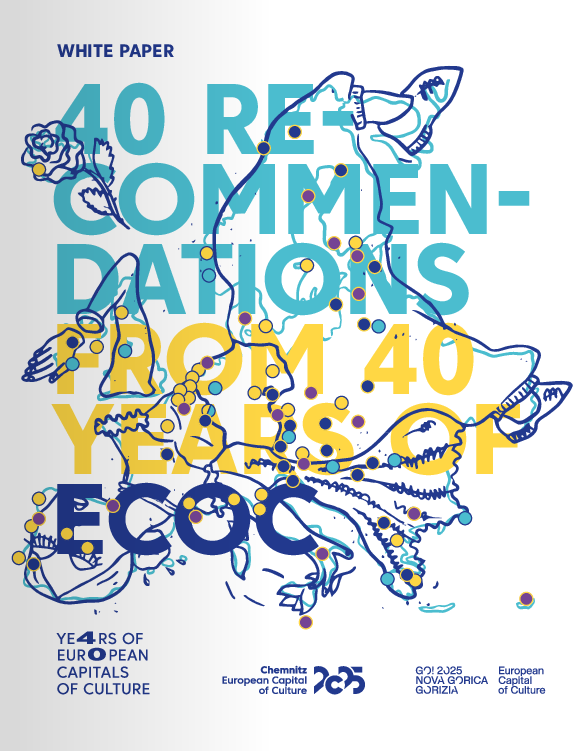
The two current European Capitals of Culture 2025 Chemnitz and Nova Gorica/Gorizia were invited to present the white paper "40 recommendations from 40 years of ECoC*: Insights for the European Capitals of Culture from 2034" for consultation and presentation. It is intended to form the basis for a new legal foundation for the European Capitals of Culture. This conference marks the start of a process designed to ensure the continued existence and further development of Europe's largest cultural project, which was initiated exactly 40 years ago.
The results of the meeting will be presented at a press conference on Friday, 4 April at 12.30 pm in the Carlowitz Hall of the Carlowitz Congress Centre Chemnitz. The press conference will be held in English.
The meeting will begin on Thursday, 3 April at 7 p.m. with a reception hosted by Chemnitz Mayor Sven Schulze at the Hartmannfabrik, the Chemnitz 2025 visitor centre, and on Friday, 4 April, panels and working groups will take place in the Carlowitz Congress Centre from 9 a.m. onwards.
The detailed conference programme can be found here.
Participation in the conference
The conference is aimed at a specialist audience. Media representatives have the opportunity to register for the conference via the press office of the City of Chemnitz at press office(at)stadt-chemnitz.de for accreditation.
Background
The conference marks the start of a process designed to ensure the continued existence and further development of Europe's largest cultural project. In a joint research project, Chemnitz and Nova Gorica have carried out a comprehensive study among the management and artistic directors of former and future European Capitals of Culture. Under the direction of Italian researcher Valentina Montalto from the KEDGE Business School in Paris, an Italian-Slovenian team interviewed 64 of the 82 cities that have held or will hold the title of European Capital of Culture about their experiences and perspectives.
The findings are summarised in 40 theses in the "Chemnitz White Paper" guidelines and are being incorporated into the revision of the European directive on the scope of the European Capitals of Culture. The aim is to strengthen the European dimension, simplify the selection and monitoring process and ensure long-term implementation. In addition, the Melina Mercouri Prize is to be revised in order to facilitate early funding.
The dialogue between the European Commission, the European Council and the European Parliament will begin in autumn 2025. The revised directive is to be adopted by 2027 and apply to cities that will hold the title from 2034.
40 years of ECoC*
In 2025, the European Capital of Culture (ECoC) project, an initiative of the European Union, will celebrate its 40th anniversary. Since 1985, cities have been selected to build bridges between countries through art and culture and to strengthen the diversity of European cultures. The programme was launched by the then Ministers of Culture Melina Mercouri (Greece) and Jack Lang (France).
Press contacts
Mareike Holfeld
Phone: 0371 33563110
Mobile: +49 151 51291178
mareike.holfeld@chemnitz2025.de
Press Office City of Chemnitz
Franziska Wöllner
Phone: 0371 4881533
Mobile: +49 175 785 84 17