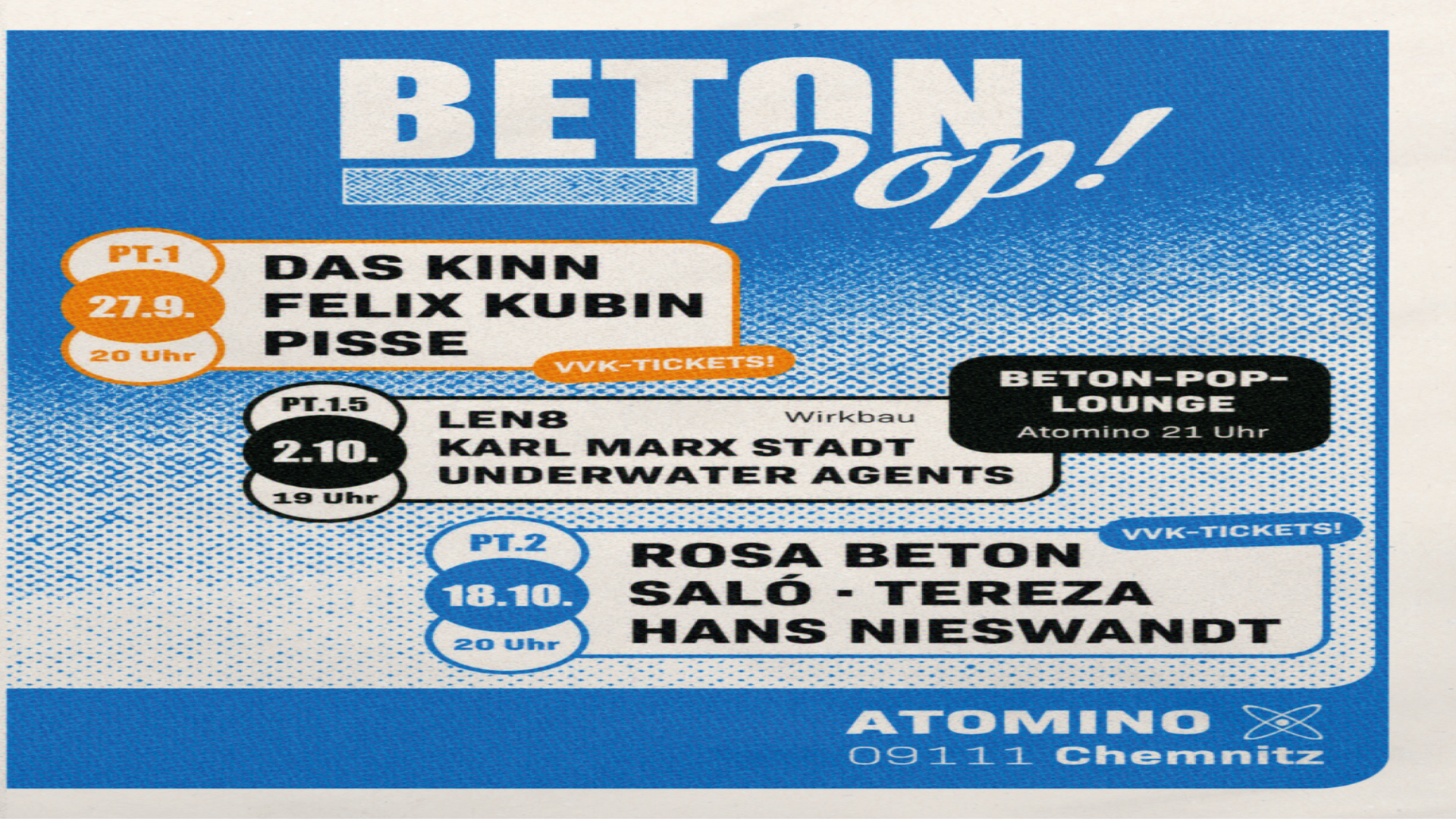
Framed by the"Sicht Beton" exhibition at Wirkbau, three acts featured on the "Beton-Pop" compilation will present their respective sound versions in an approach to the thematised material.
Karl Marx Stadt is a project by Christian Gierden, who grew up in Chemnitz and now lives in Berlin. He can move confidently between an advanced listening landscape and acid-squeaky electro-pop, but also has an eventful sound past as a member of the breakcore group Society Suckers. His contribution on "Beton-Pop" is inspired by Stockhausen's "Beton-Studie" and was created in West Berlin's Plattenbau, but has a completely different local association as a retrospective "Sonnenberg" study.
LEN8 is the pseudonym chosen for ambient and experimental electronic productions by a Leipzig-based producer and label operator (Alphacut and 45Seven) who otherwise works as LXC and is also featured as LXC on "Beton-Pop", with a brute version of a track by Belgrade post-punk heroes Disciplina Kicme. The LEN8 contribution, on the other hand, is a Sounds'n'Poetry collaboration with the Underwater Agents, the related offshoot of Zonic (platform for: cultural fringe views and moments of involvement) and Al-Haca Soundsystem. The latter's set will begin with a "concrete pop" introduction by Zonic operator Alexander Pehlemann.
All three involved parties will then present their selection of "concrete pop" lounge sounds at Atomino.